




Roscommon University Hospital uses Validation Manager to standardize verifications across laboratory projects

About Roscommon University Hospital
Roscommon University Hospital’s Pathology Service provides routine and emergency diagnostic services in Blood Sciences and Transfusion. It is part of the Laboratory Directorate of the Saolta University Healthcare Group and operates within the wider HSE West and North West hospital network.
1 Background
From manual spreadsheets to a standardized process
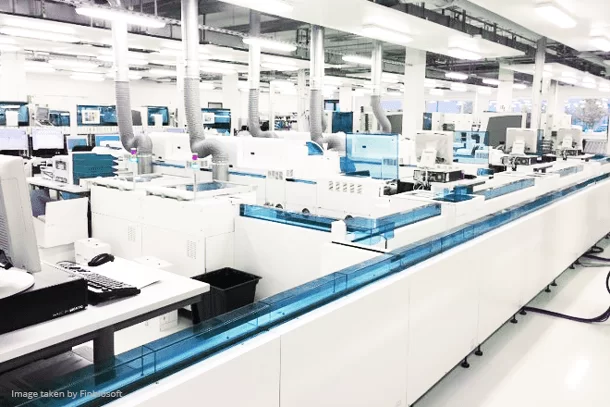
When new Roche chemistry analyzers were installed at the laboratory at RUH, the team needed to coordinate verification plans based on ISO requirements, while making the work manageable for both individual users in the background of minimal lab staff availability away from routine work.
Before Validation Manager, the laboratory relied on prepared Excel templates. Data analysis was manual, calculations were difficult to manage and the spreadsheets were not flexible enough for every sample type. Several people could view, edit and comment on the files, but the process did not provide the traceability the team needed. Reports were also written manually, with individual sheets copied into the final documentation.
Validation Manager has since enabled a more standardized and collaborative approach. The team can reuse templates and plans from earlier studies, divide work between different people and prepare project reports for adaptation to its accreditation requirements.

2 Implementation
Standardizing verifications from planning to reporting

The team had already been using Validation Manager for approximately one year. After training, staff began applying the software immediately and found it simple and intuitive to learn. Validation Manager was then used for each analyzer in the rollout.
Verification projects can be done by one person or managed collaboratively. The laboratory now works from a standard template and can copy or reuse plans from earlier studies instead of rebuilding each project.
The team uses several routes for bringing data into Validation Manager. Most data is imported from instrument files, with middleware and Excel used when appropriate. Direct instrument file import worked particularly well with the Roche analyzers and reduced the need for manual data entry.
Project reports were adjusted to meet local accreditation requirements, including the need to display specific information in one table. The team also prepares a concise summary for reviewers, while the detailed report can be transferred into the laboratory’s system.

3 Result
Faster, more focused verification across sites
Once a study has been set up, Validation Manager makes the rest of the verification process much faster. By reducing manual data entry and directing attention to the results that matter, Validation Manager helps the team work more efficiently.
The laboratory now uses it for routine work, new analyzer projects, linearity studies and point-of-care verifications. Reflecting these benefits, the laboratory gives Validation Manager a recommendation score of 9 out of 10, describing it as standardized, easy to use and well suited to collaboration.

4 Key outcomes

-
Standardized and reusable verification plans. Templates and earlier study plans can be copied and adapted for new projects.
-
Faster work after initial setup. Once a study has been planned, the rest of the verification process becomes extremely fast.
-
Less manual data entry. Instrument file imports, middleware and Excel provide flexible routes for bringing data into the platform.
-
Flexible collaboration. Data entry and project tasks can be divided between staff, while smaller projects can be managed by one person.
-
Improved traceability. Validation studies are managed within a structured workflow rather than shared spreadsheets where changes could not be traced.
