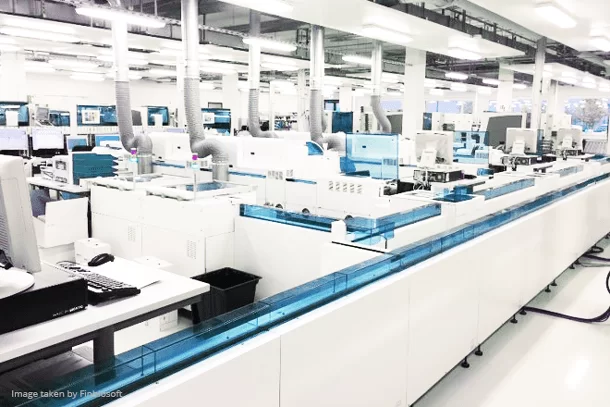





Vendor-neutral laboratory middleware for scalable, interoperable, and data-driven laboratory operations

Vendor-neutral laboratory middleware enables laboratories to connect instruments and LIS platforms through a centralized integration layer independent of any single vendor ecosystem. As laboratories face growing test volumes, staffing shortages, and increasingly complex IT environments, laboratory middleware helps improve lab data integration, strengthen lab connectivity, and standardize workflows across systems and sites. By consolidating and structuring laboratory data within a flexible integration platform, vendor-neutral middleware supports laboratory automation, compliance, operational visibility, and scalable growth while reducing IT complexity and vendor lock-in.

Key takeaways
- Vendor-neutral middleware improves lab data integration
- Centralized data orchestration strengthens interoperability and workflow consistency
- Laboratory automation helps reduce manual workloads and support staffing efficiency
- Flexible middleware architectures simplify scaling across sites and disciplines
- Open and interoperable infrastructures reduce vendor lock-in and support long-term agility
Explore how Lab Composer can help your laboratory improve automation, data visibility, interoperability, and scalability
The growing challenge of laboratory data management
Laboratories are generating more data than ever before. Expanding diagnostic capabilities, increasing test volumes, and rising expectations for quality and turnaround times are placing sustained pressure on operations. At the same time, laboratory IT environments remain highly fragmented. Instruments, LIS platforms, and specialized applications from multiple vendors each generate and manage data differently, creating disconnected systems and inconsistent workflows.
This fragmentation is no longer just a technical issue. It directly affects laboratories’ ability to:
-
access and structure data efficiently,
-
automate workflows,
-
maintain consistency across sites,
-
and fully leverage operational and clinical insights.
As healthcare becomes increasingly data-driven, laboratory data management is evolving from an IT concern into a strategic operational priority.
From data fragmentation to data orchestration
Traditional middleware was primarily designed to connect instruments and LIS systems. Today, laboratories require much more than connectivity. Modern laboratory operations depend on data orchestration, where data is standardized, governed, traceable, and usable across workflows. Closed vendor architectures make this difficult. They restrict access to data, create dependencies, and make changes costly. Vendor-neutral laboratory middleware introduces an independent integration layer that decouples data from vendor-specific architectures. This allows laboratories to capture, standardize, and manage data consistently across their entire environment. Middleware is no longer just an interface layer. It becomes a scalable laboratory data platform.
Interoperability is the foundation for laboratory operations
Laboratories typically operate instruments from multiple manufacturers, each using different standards, interfaces, and communication protocols. Without a unified integration framework, laboratory data remains fragmented with limited operational visibility. Vendor-neutral middleware strengthens lab connectivity by providing a standardized integration framework supported by dedicated instrument interfaces and centralized data management. The benefits are immediate: fewer interfaces to maintain, reduced IT complexity, more reliable data exchange, and a unified view of laboratory activity.
Standardizing laboratory workflows through structured data
Centralizing data is only the first step. Its value emerges when it is structured and used consistently. Vendor-neutral middleware enables laboratories to standardize:
-
result validation,
-
quality control management,
-
exception handling,
-
workflow routing,
-
and data governance policies.
It supports all disciplines within a single platform: clinical chemistry, hematology, immunology, and molecular diagnostics, while preserving their specific workflow requirements. This ensures that data is not only available, but also managed in a controlled, traceable, and optimized manner. As a result, laboratories reduce variability in practices, improve data quality, and strengthen compliance with regulatory requirements. In multi-site environments, this consistency becomes a key driver of quality and operational alignment.
Turning laboratory data into operational performance
The real value of data lies in its ability to improve day-to-day operations. By consolidating and structuring data across all activities, vendor-neutral middleware enables laboratories to automate workflows, reduce manual interventions, and better manage workload distribution. Concretely, this translates into:
-
faster turnaround times (TAT)
-
reduced manual validation effort
-
smoother and more reliable workflows
-
improved ability to maintain performance despite staffing shortages
Automation also allows laboratory professionals to focus more on high-value analytical and clinical tasks rather than repetitive administrative processes.
Scaling laboratory operations without increasing complexity
As laboratory networks grow, scalability depends on the ability to manage data consistently across sites and systems. As laboratory groups continue to consolidate through mergers and network expansion, standardized and interoperable data management becomes increasingly critical for maintaining operational consistency across sites. Vendor-neutral middleware provides a centralized data backbone that allows laboratories to integrate new instruments, onboard additional sites, and extend testing activities without disrupting existing workflows. Because data models and integrations are standardized, scaling becomes more predictable and less resource-intensive. Laboratories can grow while maintaining consistency and control over their data. This flexibility is particularly valuable for healthcare systems seeking to harmonize operations across distributed laboratory environments.
Data independence as a strategic advantage
Vendor neutrality is not only about interoperability, it is about maintaining control over data. By decoupling data from vendor-specific systems, laboratories retain ownership of their data and avoid being locked into proprietary ecosystems. This gives them the flexibility to:
-
select or change instruments based on needs
-
evolve their IT environment
-
and even replace their LIS without major reimplementation
Over time, this independence significantly reduces transformation costs and increases agility.
Strengthening compliance, security, and operational resilience
As data becomes central to laboratory operations, its security and availability are critical. Vendor-neutral middleware strengthens governance by centralizing data management, enforcing controlled access, and ensuring full traceability through audit trails. It also contributes to operational resilience by improving system robustness and supporting business continuity. In a highly regulated environment, reliable and secure data management is not optional, it is essential.
Simplifying laboratory IT infrastructure and reducing costs
Fragmented IT environments often lead to duplicated functionalities, inconsistent data, and high maintenance costs. By consolidating capabilities into a single platform, vendor-neutral middleware simplifies the IT landscape and reduces overall complexity. This enables laboratories to:
-
lower integration and maintenance costs
-
eliminate redundant systems
-
adopt a more sustainable long-term cost model
Simplification is not just an IT benefit, it is a key lever for unlocking data value.
Enhancing visibility and supporting better decision-making
When data is centralized and structured, it becomes a powerful decision support asset. Vendor-neutral middleware enables real-time visibility across laboratory operations and provides access to key performance indicators. This improved visibility allows laboratories to:
-
identify bottlenecks and inefficiencies
-
optimize workflows and resource utilization
-
and make faster, more informed operational decisions
Greater visibility also improves coordination across teams, systems, and sites.
Preparing laboratories for a more data-driven future
Healthcare is becoming increasingly data-driven, with growing reliance on analytics, digital health, and evolving regulatory requirements. Vendor-neutral middleware provides a modular and extensible architecture that allows laboratories to continuously adapt, integrate new technologies, and leverage emerging data capabilities without disruption. It ensures long-term agility while protecting existing investments.
From data integration to data strategy
Vendor-neutral middleware is no longer just about connecting systems. It is about enabling laboratories to take full control of their data. By centralizing, structuring, and orchestrating data across instruments, applications, and workflows, laboratories move beyond fragmented data silos toward interoperable, automated, and data-driven operations. AI and advanced analytics will only deliver meaningful value if laboratory data is reliable, consistent, and readily accessible. Without a strong data foundation, their impact remains limited. This is a fundamental shift from managing data flows to building a true data strategy.

You might also be interested in
-
How laboratory automation software optimizes workflows and operational performance
Read the article -

How to set performance goals in Validation Manager: absolute, relative and range-specific goals
Read the article -

What do you hope to achieve with Validation Manager – and how to make it happen
Read the article


